Tribhanga Here, There and Everywhere

August 27, 2009

So about two years ago I had linked to the blog of a guy called Anil Menon, where I had got a whole bunch of fundaes which I used to make questions for my KQA quiz. This year, I found out that Anil Menon is actually a sci-fi writer. Here is an interview of Anil Menon by Vandana Singh.

I found the blog because I had been searching for more information on the Tribhanga pose, which it provided in great detail. If you didn’t read that post when I first linked to it in 2007, read it now. It’s brilliant.

The tribhanga is a pose in which the body twists or flexes thrice – on the leg, the waist, and the upper body. Because this pose comes more naturally to women than men, Chola sculptors used it in their statues of Parvati to emphasise her feminity, something I learnt in V Ramachandran’s Rieth lecture on the neurological basis for art appreciation. I found the Reith lecture (and then decided to set a question on the funda) in a link from Ravages, who had been photographing the Chola bronzes. I can’t find the original photos he had posted then, but here’s one he posted more recently: 
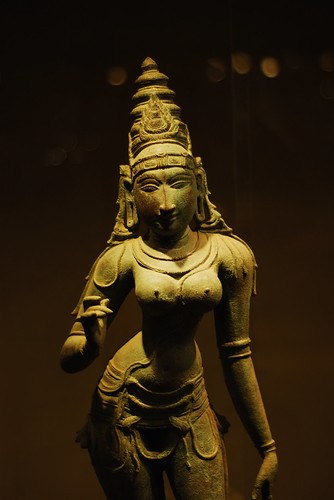
Parvati

And here is a photo of a lady in Raffles City mall who is checking her iPhone while standing in tribhanga:
Tribhanga

Her face is obscured, so there are fortunately no privacy issues. It’s also a happy coincidence that I got this snap – I was practicing manual focus on the awesome 50 mm f/1.8 lens while waiting for a friend to join me at lunch, and didn’t notice that I had got this tribhanga snap until I came home and transferred my pics.

Incidentally, the Wii Fit – in sharp contrast to Anil Menon – insists that the tribhanga is a terrible thing and that standing in this pose is the road to ruined posture, upper body weakness, and spinal injury. In a shocking display of Nipponese hypocrisy, the animations for the yoga and stength exercises show the trainers standing with their bodies flexed before the routine actually starts.


The Logical Extreme

August 21, 2009

Supporting freedom of speech and expression is a bit of a spectrum. On one end there is the complete commitment to free speech, consequences to anybody be damned. On the other end there is North Korea.

In between, there’s the hypocritical commitment to free speech in Indian politics where Shashi Tharoor will criticise Modi banning Jaswant Sinha’s book but say nothing about Congress government bans on Nine Hours to Rama, The Satanic Verses, and James Laine’s books. There’re also the Hindutvawadis who are all for free speech when it comes to Taslima Nasreen and the Danish Muhammad cartoons, but suddenly do an about face when it comes to MF Hussain and the poor chap in Vadodara.

But even if you’re not committed to free speech at a fundamental or ideological level, there’s a very good selfish reason to support it, or to speak up for any poor bastard who’s getting thulped for having caused offense: if people who are actually offensive and obnoxious can get away with it, people who’re entirely innocent don’t have anything to worry about. If Muslims can depict Hindu gods any way they like even if they are blatantly hurtful or derogatory, Hindus can also depcit gods in any manner, even if these are not traditional and a little edgy. Conversely, if offended Hindus can get away with hounding Muslims, they’ll soon start going after offensive Hindus too. And apparently we have already slipped down that particular slope:

Dr Subodh Kerkar, an artist based in the holiday resort state of Goa, had announced the exhibition of his sketches, which depicts Lord Ganesh in different form including the one holding Oscar award.

I have been receiving phone calls which threatens me with dire consequences. They told me that they will chop off my fingers for indulging in such act, Dr Kerkar told daijiworld from his gallery at Calangute, a beach village in North Goa.

The series of calls for the painter started when Sanatan Saustha, a hard core Hindu organization through its mouthpiece, Sanatan Prabhat carried the sketches appealing `Hindus to call up Dr Kerkar and express their anguish.

The paintings means no offence to any religion. They are my ex-pression of creativity, Dr Kerkar said. The painter said that he himself is a devotee of Lord Ganesh and has always been inspired by him.

(daijiworld)

He got into trouble for painting Ganesh with an Oscar. At this rate Tantra T-shirts are doomed.

Once upon a time, being violent to members of your religion for not being pious enough was something that the Dukhtaran-e-Millat used to do in Kashmir. It’s tragic that now we Hindus are sinking to that level.


Of Chinese love for cute things, of shanghainese men and of Chinese babies & nappies

August 20, 2009

Wanted to post this for a long time now; but travel, viral infection and lack of photographic evidence delayed the same. Since the travel is not going to slowdown, I decided to go ahead and post this and add photographs later.

Let me start with the Chinese love for all cute things – before which I may add that the Chinese people themselves are very cute and endearing for their Barbie doll personalities; specially the women. There is something about the Chinese and their love for soft toys, baby doll dresses, cute clips, hair bands, bling bags, cartoon character car seat covers – the list is endless. While this by itself is not surprising, what stands out is the fact that it’s not just the teenagers who are hooked onto the cute stuff but even their moms. So it’s normal to see a 40 something Chinese lady with a cute pink teddy bear hanging from her mobile phone (which may also be pink) and driving a car which has tweety car seat cushions and her office cubicle will be full of cute little soft toys. Also she would be wearing a baby doll dress with purple mascara or in some cases purple highlights to the hair. Her laptop bag may again be a very girly bag with some cartoon character and she may wear pink or violet sandals. Now, before you get me wrong, I must highlight the point I am trying to make here – The 40 something Chinese woman can carry all this off! Can you ever imagine the average 40 something Indian woman in a baby doll dress with stuff she would buy for her kids? (While our 40 something heroes are in some cases able to carry off a college boy look complete with pink tees, actresses at that age are only offered “maa/ bhabhi” roles). And then you hear people saying how it’s not easy to determine the age of the Chinese – that because they really don’t age; mentally at least.

Now having spoken about the women let me dwell on the average Shanghainese man. He is the perfect husband/ boyfriend every woman dreams of having – It is said that the average Shanghainese man treats his woman like royalty bringing her breakfast in bed, to carrying all her bags (yes including her most feminine handbags) to taking care of the kid. In fact, it is said that the men in rest of China make fun of the Shanghainese men for being so effeminate. But, nothing seems to faze the Shanghainese guy and all over the city, one can see the guy following the girl obediently or walking next to her carrying her LV/ D & G/ Prada handbag (fake one in most cases). I have been told that in some cases this royal treatment is also meted out to the girlfriend/ wife’s parents and the Shanghainese man excels at not just cooking but other household chores too. Now if only Indian men were to take some inspiration from the Shanghainese men (ok, except the handbag carrying part as that can be really effeminate).

And this brings me to the most intriguing thing about China – the aversion to use nappies for babies! The first time I saw a Chinese kid moving around I thought that this kid must belong to such a poor family that he has to wear torn clothes. But it’s only when I saw almost every kid roams around with no nappy and a slit in his trousers/ pants to facilitate parents to help them pee/ poo that I realized that this is the norm here. Unfortunately I don’t have a photograph right now, but will soon be posting one as in this case the adage “A picture is a thousand words” does hold true. I would say one of the most difficult jobs in China would be that of the marketing head of these diaper manufacturing companies. I have also heard expat friends with babies receiving “torn” clothes as gifts as the baby clothes in most local places here come with a slit! Can you imagine how lazy must be the person who invented this slit in the first place!

(Disclaimer – the writer is NOT looking to have a Shanghainese boyfriend/ husband)


Super Saturday

August 18, 2009

This Independence Day, I achieved two long-standing dreams.

The first was at the Landmark Quiz Chennai. We (me, Skimpy and Kodhi) won it.

The three of us have been taking part in the Landmark or Odyssey quizzes since 2004. We’d do our August 15/ January 26 pilgrimage to Chennai and just miss qualifying, or qualify and then come last. This year, we qualified. We didn’t get knocked out. And we were on brilliant form, cracking questions throughout the quiz and peacefully winning.

We then went into the all-India finals, and ended up losing by one question, but so it goes. No Enthu Da is now established as a quiz team. We have a reputation. Another couple of years like this, and we could start getting name recognition like QED or Mama Machaan Mapillai. Sooner or later, we’ll win the national round too.

That was dream one. The second dream got fulfilled just after the Chennai round, when the three of us were interviewed by the Chennai local news channel.

Reporter: How does it feel to win?

Kodhi: One of the things in life’s to-do list has been checked off.

Reporter: So have you been quizzing lots before this?

Wimp: Yes, we’ve been coming here and trying to win for five years now.

Reporter: So how do you feel on Independence Day? What does Independence Day mean to you?

Me: Freedom is awesome! It’s great that we have freedom and now we should help other countries with freedom too. To the north you have China being high-handed so we should support free Tibet.

Why was this fulfilling a dream? Well, the news channel is a joint venture between NDTV and The Hindu.

Abusing The Hindu in The New Indian Express is one thing. Expressing pro-Tibet opinions on a Hindu owned media outlet is one of the greatest hacks I’ve ever pulled. Now, as with the Landmark Quiz, it’s time to raise the game – the new goals are to win the national Landmark, and to somehow write an anti-China or anti-CPM oped in The Hindu itself.


Solitude

August 8, 2009

Language… has created the word “loneliness” to express the pain of being alone. And it has created the word “solitude” to express the glory of being alone. ~Paul Johannes Tillich, The Eternal Now
My house in Bombay is in the centre of action with a children’s garden, wedding hall and some popular south Indian restaurants in the neighbourhood. Unsurprisingly, for a city that never sleeps, there is never any time when there is no traffic and no noise. Even at 1 am I could walk down 20 steps to find the road side pau bhaji wala and juice centres; all doing roaring business and buzzing with people, energy and activity. Dadar station is the closest “fast” station on the western line to my house. There would be very few places in the world as crowded and chaotic as Dadar station. People visiting Bombay for the first time tend to get overwhelmed at the sight of the crowds running like their life depends on the last local; particularly at the big stations like Churchgate, VT, Dadar, etc. For Bombaites it’s a way of life – we know it no other way. Most of us have taken the last train home and also spent times painting the town red till 6 am such that we reach home when the doodhwala arrives.
So when I got to Shanghai and realized I could live on either side of the river – Puxi, which in energy and spirit reminds me of Bombay or Pudong, which is the quieter commercial and residential area; i surprised myself by choosing to live in Pudong. Not because I wanted to be close to work (as I travel 45 mins to work one way) but because I wanted to experience what one rarely gets in Bombay – SOLITUDE! I live in an area called Jinqiao which seems completely surreal to me – my building apartment stands in the middle of long alleys with trees on both sides; shops are so in descript one would barely notice them and though there are lot of people who live here, one never gets to see them. There is a Carrefour and community centre at a 10 minute walking distance – this place is frequented by people of so many different nationalities – it seems like a complete melting pot where the world has come together. It’s a congregation of a different kind and seems quite unreal.
A friend from Puxi recently visited me and she was so shocked at the tranquillity and stillness of the surroundings. She asked me how come I don’t feel scared living alone in such a quiet area. That’s when I realized that though initially the solitude had seemed very new to me; I had come to embrace it and like it in more ways than one. There are no screeching, honking, music blasting cars here. I have neighbours but never feel their presence. Of course there is no shaadi ka band bajaa which I am so used to (since I have a marriage hall right next to my house back home). The only time I remember hearing sound in my surroundings was when the Chinese New Year was being celebrated with fireworks. Otherwise the serenity and calmness is lovely – it’s quite something to be able to hear the sound of rain with no other sounds to dilute the effect. I wish I could walk into my balcony and have a sea or beach view – what I have instead is an artificial lake and villas for a view. This quietude has had amazing effect on me; making me reflect, introspect and even change a lot. I am getting so used to this that today when I speak to family and friends back home and can hear the loud traffic in the back ground, I find that disturbing enough for me to tell them to speak to me when they are in a quieter place. Truly such peace and quiet is difficult (and expensive) to get in Bombay – and that makes me value this even more!


Incorporating Heritage

August 6, 2009

Neel has a blogpost which talks about IIT-D designed board games that incorporate elements from traditional Indian stories into their design. He also laments that most Indian design and architecture does very little to showcase heritage, and picks on malls, airports and railways stations as being the worst offenders. I had some scattered thoughts about this which were too long for a comment, so here they are:

  1. One of the big problems with incorporating heritage into any venture these days is that you put yourself at grave risk of Rajan Zed issuing press releases that you are offending Hindu sentiments. In fact going by past experience it could be not just Rajan Zed but Rajput associations, Jain associations, Sikh associations, ad nauseum.
  2. Railway stations – depends on what you’re defining as heritage. When the British were building stations, they they built gorgeous facades which mixed up Mughal design elements (arches and domes), continental European decoration (the gargoyles at the station formerly known as Victoria Terminus), pre-Mughal construction (red sandstone), and some stuff which was entirely fresh from the architects’ perspective. I think that railway stations in princely states may also incorporate local architecture. It’s probably construction in post-independence India that gave us the horrible concrete blocks with no aesthetic appeal – the same applies to most of the airports.
  3. Airports – we seem to have moved from a situation where there was one single design of ugly concrete blocks being used for every airport to a situation where one single design of curved beams and glass walls is being used. Personally, I find the new one more attractive; but Neel’s point about it not having many Indian elements is valid. Delhi’s airport has made an effort with interior decoration for Terminal 1D, but this The Delhi Walla blogpost seems to suggest that it’s half-hearted.
  4. Malls – yes, these are the most egregrious offenders when it comes to cookie-cutter design and absolute lack of architectural imagination. I think that this is because somewhere there is a design handbook for malls which lays down points on laying out a mall to maximise retail sales which is being followed religiously without either any attempt to run local experiments to see what works better or imagination by architects on how to make it look cooler. [rant done] But even if architects did want to come up with cooler designs, would builders and tenants pay for them? Hm.

Another thing about heritage is that it’s desirable, but so are many other things (whether on pure functionality or for the wow-it’s-so-cool factor). So some of these are:

  1. Is it functional, innovative, valuable? Neel cribs about airports, but the fact that Delhi’s new airport has inline baggage scanning delights me so much that I hardly notice the lack of heritage design elements.
  2. Is it aesthetically pleasing? Everyone’s taste on what looks good will be different, so this is difficult to measure. But as an example, look at Jet Airways’ long-haul business and first class. Not much in the way of Indian design, but incredibly innovative and good-looking.
  3. Is it unique? This ties in with the crib about all malls and airports looking like each other. On the one hand, using a standard design brings down costs and I think China has built dozens of new airports just by reusing the same design over and over. Delhi’s new airport terminal might be standard curved beams and glass, but that standard design allows it to function on natural light throughout the day and not turn on electric lights until night – which has its own functional and aesthetic appeal. Of course, poor construction of that design is probably what led to the same terminal being flooded during the rains.
  4. Is it designed by Indians or an Indian company or even for Indian consumers? Even if it doesn’t reference existing heritage, if it’s iconic enough it could eventually become Indian heritage – like the Bombay Gothic buildings (good) or the Ambassador (bad). I know that Jagadguru has said that nationalism is the superset of religious fundamentalism which is itself the superset of terrorism, but I still think it is awesome if my national heritage is added to.

Another thing is that heritage doesn’t automatically provide quality. Air India paints Rajsthani chabutras on its aircraft windows but sucks as an airline. There have been so many animated movies about Krishna (Cartoon Network is running five this Janamashtami), but the dialogue and storytelling is usually terrible. 

So heritage is awesome, but only when the companies using it already have the capability to create great products; and also when designers and developers have the space to use their imagination.


The Indian mentality towards marriage

July 30, 2009

My mom was doing her grocery shopping and ran into an old acquaintance who normally wouldn’t talk more than a “kem chho” (how are you) but this time was very excited to share the good news of her daughter’s marriage to a “NRI chokro” (Non resident Indian bridegroom). After my mom congratulated her, she started questioning my mom about me. When my mom told her about my single status, she expressed shock and anguish almost as if she heard that I was diagnosed with swine flu or something much worse. My mom, by now a pro at this, told her that she doesn’t view it as a problem and that marriage will happen if and when it has to. But you see; to most Indian mothers, getting their daughters married off is like a B-school placement – so if you don’t get placed in slot 0 or slot 1, there has to be something terribly wrong with you. My only problem with this thinking is while you can get companies to come on campus according to slots, you don’t necessarily meet the right men early on; i.e. slot 0 or slot 1.

If one believes in the “six degrees of separation” theory, then the right person for each one should not be more than 6 degrees away – i.e. your friend’s friend’s friend’s friend’s friend could be the right one for you. But in reality meeting that right person may take ages. And what if you marry the person you think is right and then meet the right person – ouch, absolute disaster! In most parts of the world, you marry IF and WHEN you want to marry and if things don’t work out, you go your separate ways. But in India, you are almost pressurized to marry because your parents or extended family wants you to marry. If you are among the lucky ones like me, wherein your parents have left it to you when you want to marry, it still doesn’t signal the end of problems – because there is an entire army of people there right from that old family friend to the relative of your neighbor to the sister in law of your aunt who have all taken it up on themselves to find you the right person!

Things can get so irritating that after a point one may stop attending marriages of cousins, social functions to avoid the inevitable question – “beta, lagan kyare karavane che?”(When will you get married?) A simpler solution would probably be to smile and say “time che” (there is still time for that) but then you run the risk of being viewed as too western, too modern, too rebellious, etc, etc. While I get away with all this not even being present at most such occasions, it’s my mom who charmingly fields all this questions – so sweet of her.

While it is still understandable to expect the older generation to think in a certain way, what surprises me is that some of my girl friends after getting married started assuming some kind of superiority over me because of their marital status. While one is tempted to laugh at such idiocy, a single friend recently captured this very well when she said “all my friends who are in relationships or marriage have problems while I get to enjoy my life on my own terms, in fact I feel they are jealous of my single status” – well, the grass is always greener on the other side. My only contention here is it’s unfair to judge people based on their marital status and to believe that it’s customary to be married by a certain age or else it’s an aberration. Its time we let people be!

So while we send the Chandrayaan to the moon, make the maximum number of movies in the world, excel in software; I still wait for the day when we are able to break free of the stereotypes of marriage and age to get married at!!


Connections

July 29, 2009

(written in honour of Katpadi Katsa’s upcoming nuptials)

Kitty Aunty has always enjoyed weddings. But in the past few years they have been incredibly important to her. Now that her children have left the house and she no longer teaches junior school, being the centre of all weddings is how she occupies herself. Kitty Aunty has heard of the notion that a wedding is the bride’s special day, but thinks that this is a lie spread by Hollywood movies and American sitcoms. She knows that a wedding is a beast with a life of its own, which will devour the bride and groom if they’re not careful, and that only she can tame it.

And so it is Kitty Aunty who runs the weddings of her extended family behind the scenes. She knows how to negotiate a discount on the bride’s designer lehnga, and where to get equally good dresses at less obscene prices for the mothers and sisters. She knows the caterer who provides the best paneer tikkas. And the ladies who have evening tea at the Gymkhana Club still speak in awed tones of the time Kitty Aunty bargained over the groom’s juttis with a group of young and ruthless saalis, and convinced them to settle for a chaat party.

But the money and the catering and the dresses are just side businesses for Kitty Aunty. The really important job for her is information gathering and networking. For the past many years, she is the one who goes and meets the in-laws and their extended families, discusses how the wedding should be held, and finds out everything about them. The in-laws are always slightly perplexed that they are meeting Kitty Aunty rather than parents. They are also perplexed about whether she is a tai or a masi or a bua or a chachi or just a plain auntyji but they adjust.

And all this meeting in-laws and gupshup over chai leads to the whole point of the wedding. At the reception, if Gungun Mausi wants to know who that boy in the cream sherwani or the girl in the green choli is, only Kitty Aunty will be able to tell her. She will be the only person who will be able to tell Gungun Mausi their names, what they’re doing, any scandals centred around them or their families, and if they’re single and looking to get married. Kitty Aunty never does anything as crude as matchmake. But without her, matchmakers would never be able to operate. She knows this, and takes her function very seriously.

But she is not enjoying tonight’s wedding. The boy and girl have had a love marriage, which is fine by her. And the boy is not Punjabi but that is fine by her too. After all she is liberal and these days it’s better if children do things on their own. But the guest list is driving her crazy.

The bride and groom had gone to college together, and most of the guests are their batchmates and juniors and seniors. Not only do they outnumber the relatives, but very few relatives beyond immediate family have even been invited. Almost three fourths of the guests are the couple’s friends. Worse, they are all each others’ friends. Nobody is asking Kitty Aunty who anybody else is, because everyone knows already. She feels useless and exasperated. She had grown accustomed to being at the centre of all information. Now she is at the periphery. She has to ask guests who other guests are.

It’s fine if a girl and boy who get married don’t have the same caste or background, she reflects. But she draws the line at them having the same friends.


Busna Ae Haseeno!

July 29, 2009

A bus ride in Shanghai.
It was late in the evening and the bus was amazingly crowded, but I got in nevertheless. There was hardly any space and it was difficult not to step onto each other’s toes. While standing there, trying to balance myself in the midst of a lot of local Chinese; it struck me how I would never be able to travel in as crowded a bus in India with such ease. Earlier in the evening, I had read about the stripping incident in Patna in broad daylight. A 2006 report by the National Crime Records Bureau said in India a woman is raped every half hour and is killed every 75 minutes. And considering that only one in 10 rape cases get reported, the actual statistics would be mind numbing. Also, almost every woman in India would have experienced some form of leching, eve teasing, etc. When I pointed out to a friend that Chinese men don’t even look, forget staring, leching, eve teasing, bottom pinching, etc; he said it may be because they are careful when dealing with foreigners. This led me to discuss this with a few of my local Chinese female friends who also confirmed that they have never felt a man stare at them or try to misbehave while walking on the road or using public transport. This is in fact one of the cities wherein a woman feels safe unescorted even at 3 am. Another friend jokingly speculated on the testosterone levels of the Chinese males. I dismissed this logic immediately as to me the reason for the Chinese men being so well behaved and decent is largely attributed to the fact that there is more respect for women; percentage of working women much higher compared to India and the society here is more open in terms of acceptance of women as equals.There is an equal amount of pride in culture , civilization & ways of the past. However there are no taboos on sex, sleaze & porn. There is also a certain degree of openness about sex and u wont find too many people gawping when couples snuggle in the open. Nor will you find too many self proclaimed guardians of moral values of society who abhor ‘promiscuity’ of any kind and are a law unto themselves.
And this brings me back to the experience of my firang friends in India; most non-Indian women friends of mine have shared with me how they feel unsafe to walk on the road in one of the supposedly safest cities of India, Bombay. In fact, in India tourists are often soft targets. So while I enjoy the bus rides here, I wait for a day when I can board a bus anywhere in India without hesitation!


China calling

July 27, 2009

While growing up in India, particularly during my graduation course, we were constantly talking about the only other economy in the world that was growing faster than India – China. China had always fascinated me and I wanted more than anything else to get a first hand experience of working and living in China. So when given the opportunity, I was more than happy to come here with an open mind and soak in the different culture and experience.

I have been here for more than a year now and this country doesn’t cease to fascinate and amaze me. I have traveled to more than fifteen cities in China and have loved the scenic beauty, different cultures region wise, and most importantly the people – they are so nice, helpful, welcoming that I feel at home here. Traveling; both intra city and inter city is very convenient with excellent infrastructure in place. The public transport system in Shanghai is very efficient and I use the subway and buses frequently.

Work wise, it has been a great learning curve – the work environment here is extremely positive and buzzing with energy. Also it’s a very multicultural environment with a lot of respect for each other. I am learning the language and have fallen in love with it – though my Chinese is not very good – wo de zhongwen bu tai hao; wo hai zai xuexi. But whatever little of the language I can manage helps create a good bonding with the locals; specially the shopkeepers, taxi drivers, etc. Another difference for me was experiencing four different seasons and I must say I quite enjoyed it.

I have become an unofficial ambassador of China in India and vice versa. Most people in India are surprised and some even shocked to know I work in China and have a barrage of questions. Its amazing how in spite of being neighbors we know so little about each other. It was also a bit surprising for me initially to see how there are more than 30 Indian restaurants in Shanghai (I didn’t expect so many Indian restaurants here) and one can also get all Indian groceries here. But as I got to know Shanghai more, I realized how international and cosmopolitan the city is – It’s a true melting pot of different cultures.

Having said all these; the question which most people ask me is if I would like to stay longer in China – and my answer is “of course – wo hen xihuan zhongguo”!!